
Perimeter Monitoring Systems for Construction & Demolition Sites

Summary: Perimeter monitoring helps construction and demolition site managers reduce impacts to off-Site receptors from airborne dust and VOCs. This article explains how AirLogics uses mobile AQS 1 monitoring systems, strategic station placement, real-time data, calibration controls, and project-specific planning to collect useful information near off-site receptors.
Construction and demolition sites can generate dust and airborne compounds that move beyond the active work area. Perimeter air monitoring helps site managers track conditions at the property boundary, evaluate potential impacts to prevent the impact of nearby off-site receptors, and maintain a record of changing site conditions. A well-planned perimeter plan or program can support demolition, excavation, material handling, building removal, and other activities that may affect air quality around a project.
Why Site Boundaries Need Real-time Data
A construction or demolition project can affect the air around its boundary through dust, particulate matter, and volatile organic compounds, also called VOCs. Nearby homes, businesses, schools, and other properties may be located close to the work area.
Real-time perimeter monitoring gives project teams measured data near sensitive locations instead of relying only on visual observations. Monitoring stations can record conditions over time and provide actionable information about data in regard to what is occurring at and beyond the site boundary.
Readings can then be compared with specific work activities, such as demolition, soil movement, loading, or material removal, giving the project team a practical way to review changing site conditions.
What A Perimeter System Can Measure
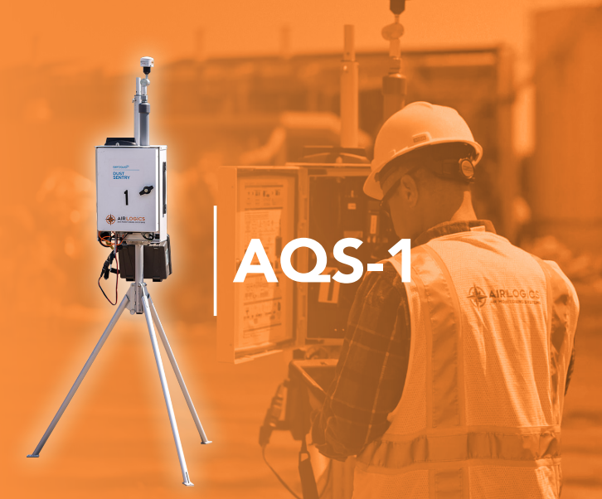
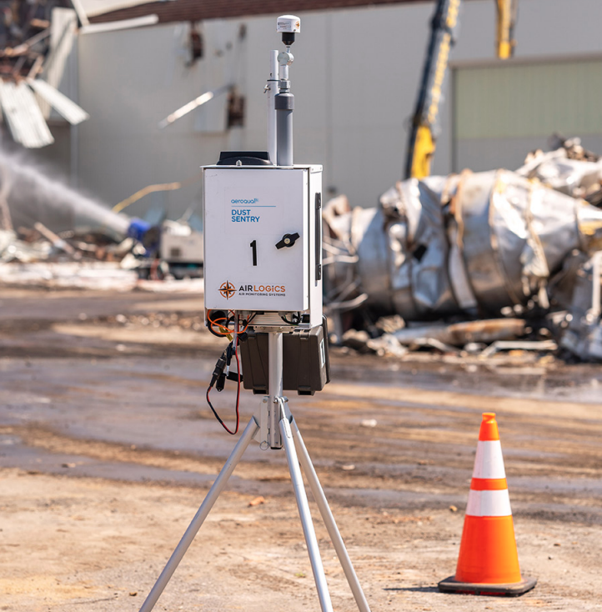
A useful perimeter monitoring system should match the conditions and concerns of the project. AirLogics uses the AQS 1, a light and mobile monitoring unit that can be configured for several measurements.
The system can measure total VOCs through a photoionization detector, along with PM2.5, PM10, total suspended particulate matter, and noise. Gravimetric sampling can be used for projects that need collected particulate samples for later analysis.
This flexibility allows the monitoring approach to focus on parameters that are meaningful for the site, rather than collecting data with limited project value.
The AQS 1 can also use a lithium battery, solar charging, or 110 power. This gives AirLogics several options for placing equipment at a site. Its light design makes it easier to move the unit to a different monitoring point as project needs change.
Placement Matters More Than Quantity
A monitoring unit is only useful if its location supports the purpose of the project. AirLogics considers the site layout, nearby receptors, prevailing air movement, project activity, and possible emission points during planning.
Stations should be located where they can help answer the project’s key questions, such as whether work activities could affect nearby receptors or selected boundary areas.
Large demolition projects may require several monitoring points, while smaller construction sites may need fewer locations. The number of stations should be based on site layout, work sequence, and monitoring objectives.
Monitoring locations should also be reviewed as work progresses. A demolition site may have one area of concern during building removal and another during later material handling, so station placement should remain tied to the areas that matter most.
Advanced Instrumentation and High- Quality Equipment
The AQS 1 uses a pumped sampling system that keeps air moving through the sensor modules. Filters help protect the sensors from airborne impurities. Its automatic baseline correction checks the zero baseline every 60 seconds, helping address sensor drift and cross-interference.
The system also supports factory and field calibration. Sensor modules are calibrated against high-purity gas standards prepared under ISO 6143. Field calibration uses reference materials and methods aligned with certified analyzer practices.
An on-board heater helps reduce issues created by humidity-related interferences that can affect some optical particle measurements that plague other lesser systems.
Together, these features support consistent field data collection. The AQS 1 also uses a Met One Instruments nephelometer for particulate measurement, adding another level of reliability for projects where particulate monitoring is a priority.
A Practical Tool for Projects
Construction and demolition projects often have tight boundaries and nearby receptors, making perimeter data useful for planning, documentation, and communication.
AirLogics systems can be adapted to a specific location and project phase through flexible power options, mobile equipment, and configurable monitoring parameters.
The strongest monitoring programs combine appropriate station placement, suitable measurements, reliable calibration, and consistent data review.
The AQS 1 can support multiple project stages, with modular sensors and sampling options selected to match site-specific needs.
When readings are reviewed alongside the timing and location of site activities, the collected information becomes easier to interpret and more useful for project records.
Closing Thoughts:
Every project has a different layout, activity pattern, and receptor profile. A practical perimeter air monitoring plan starts with those facts and defines the monitoring points, selected parameters, sampling methods, data review process, and project-specific response steps. By focusing on the information needed at the property boundary, the project team can select the right sensors, place stations where they are most useful, and review data in the context of actual site work. AirLogics can help develop a focused monitoring approach for construction and demolition sites where dust, particulate matter, VOCs, noise, and nearby receptors are important considerations.
Contact AirLogics to discuss your site layout, monitoring goals, and equipment needs.
FAQs:
1. What is perimeter air monitoring used for?
Perimeter air monitoring measures air conditions near a site boundary. AirLogics uses it to collect data relevant to nearby off-site receptors.
2. What can a perimeter monitoring system measure?
A perimeter monitoring system can measure total VOCs, PM2.5, PM10, total suspended particulate matter, noise, and collected particulate samples when gravimetric sampling is needed.
3. Where should air monitoring equipment be placed?
AirLogics considers site layout, nearby receptors, air movement, work areas, and possible emission points to select useful monitoring locations.
4. Why are real-time air readings useful?
Real-time readings show changes as site activities occur. AirLogics data can help connect measured changes with demolition or construction activities.
5. What should a perimeter monitoring plan include?
A practical plan can identify monitoring points, selected measurements, sampling methods, data review steps, and actions based on project needs.

Comments